Last week I was in a small tailor's shop, I looked around and saw that the items they use there on a daily basis are things that I only knew from museums. Things that my great-grandmother used to have: a foot-pedal driven sewing machine and a iron that gets filled with hot coals. Life in Togo is like stepping back 30 maybe even as much as 50 years back in time, with odd additions of modern life as cyber cafes are rife and mobile phones jingle. Unfortunately life in hospitals in Togo is also antiquated.
Yesterday morning PDH was contacted by the extended family of a two month old boy called Alexandre. His family is in need of financial aid, the money has just simply run out. His mother is ill, one side of her face is severely swollen, she has been to doctors and tried various medications, all without success and now her two month old baby is ill. He has been in hospital for five days now, hooked up to oxygen. A venflon seemingly to big for his little hand, allows his IV to be hooked up occassionally to administer fluids. He is in obvious respiratory distress and the docs here suspect a congenital heart condition. He needs an ultrasound of his heart. For this to be done he needs to be transferred to a private clinic, something that was supposed to happen yesterday. It has been postponed without obvious reasons. Outside the ward his father vents some of his frustration to us, worry, fear and anger show on his face, but also despair and hopelessness. He is clinging to PDH, hoping that they can provide some help. This time though, just paying the bills might not be enough, things are beyond the scope and influence sphere of PDH. Alexandre's condition is deteriorating, without timely and adequate medical intervention I am uncertain that he will survive.
Frustration levels are running high. How can one of the largest hospitals in Togo, one associated with a university for that matter, be unable to administer an ultrasound? Why does this boy have to suffer from something, and possibly die from it, that could be fixed in the West? Why is it that a total hospital bill of less than $60 so far is insurmountable for his family?
The pediatric ward that Alexandre is on is very overcrowded. There are crying babies everywhere, families bringing food, sleeping in chairs by their children's cots, just trying to survive. From the corner of my eye I spy a little girl with a hydrocephalus. Her mother talks to Yoka, the girl has had surgery to put a drain in but she is not getting better. She is lethargic and very hot to the touch, possibly an infection, but the family is too poor to afford additional care. As I step outside the ward a man walks up to me, can I please come over to his friend's child and take a look at it. The child is not doing well and its eyes are starting to bulge out of their sockets he tells me. I decline politely, stating that I am not a physician and will be unable to help.
At the dinner table last night it is concluded that money talks, it buys healthcare, it buys education, it buys food to feed your children. Money is also what is distinctly lacking here, forcing people to choose between their own health and their children's, between health and food. But what good is it to have a healthy child without parents, or medication when you can't support your body nutritionally? There are just so many people here who need help that it sometimes appears an impossible task. However, our presence here has brought many smiles to the faces of children whose education we are sponsoring. A man with HIV I visited the other day clutched my hand as I was about to leave and thanked me for coming to see him, for taking an interest in the problems here.
It is good to step outside the comfortable Western bubble, into the harsh African reality, though at night I twist and turn as images of the day run through my head: children with HIV, children with curable diseases that die here, children with extreme dispair on their faces. This is Africa.
This blog is about the volunteer experience of Saskia van Manen and Yoka Heijstek in Togo, West-Africa for a very small non-profit organization, called PDH: "La Promotion et Developpement Humain", The Promotion and Human Development Organization.

Please note
Due to very sporadic availibily of electricity and the internet his week (this past weekend Togo just wasn't on-line, none of it, nowhere!) two new posts have just been posted at the same time! Happy reading!
Pictures
The internet cafe has a very slow connection; unfortunately pictures have to wait, but we have some good ones...
Schedule
Yoka will fly from Boston to London on Thurday May 29 early in the morning. On Friday the 30th both Yoka and Saskia will fly from London to Accra, the capital of Ghana. On Saturday night they will stay at a hotel near the beach where African drumming and dances will be performed. On Sunday, May 31 they will be picked up by a representative of PDH and will cross the border to Togo, which is a 2 hour drive. On July 4th they will return to Ghana for a few days of relaxing and sightseeing before flying back to London on July 9. Yoka will arrive in Boston on July 11.
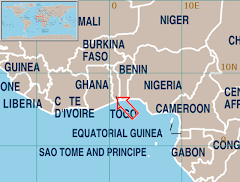
Map of Togo
No comments:
Post a Comment