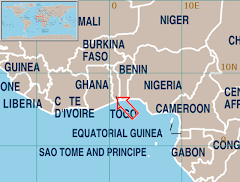
After the september presentation we have discussed different ways how to help PDH and the people of Togo further. We now have an organization called "Tales of Togo" and "Project Echelle", which is part of Tales of Togo, will raise funds to support different programs via PDH in Togo.
Early next year we will start the process of applying for a non-profit status in the USA.
As a start we have decided to be at two different Christmas Fairs in December. On Saturday December 6th we will have a stand at the Holiday Craft Fair at Rolling Ridge Retreat and Conference Center in North Andover. On Sunday December 7 we will be at the Alternative Christmas Fair in the Hancock Church in Lexington. At both Fairs we will sell illuminated glass blocks and picture perfect cards to generate funds. In addition our neighbors, Elif and Yonet, have teamed up with us to sell beautiful Ebru, or paper marble, an old Ottoman tradition stemming back from the 15th century. Ebru will be sold framed and as beautiful postcards.
All proceeds of the Fairs are going towards Project Echelle to support the projects via PDH.
We have also ordered handbags, placemats and napkins made by the people in Togo. The fabric is very vibrant and typical Togolese and I am very much looking forward to receiving the first shipment. Unfortunately it takes very long for it to arrive and I hope it will come in time for the Holiday Fairs.
Saturday, November 29, 2008

Wednesday, July 23, 2008
Presentation at Sunday September 7, 2008
On Sunday September 7, 2008 Saskia and I will give a powerpoint presentation about our experiences in Togo and an evite invitation will follow in August.
We can show you many pictures, tell you many stories and let you all know what happened with your donations of goods and money.
We hope you will be able to come for an afternoon of sharing drinks, food, photos and fun.
We can show you many pictures, tell you many stories and let you all know what happened with your donations of goods and money.
We hope you will be able to come for an afternoon of sharing drinks, food, photos and fun.
Pictures

School Children

Street Scene in Lome

Cooking Lunch

Pediatric Ward at the
University Hospital in Lome

Creative Time at PDH

Siblings coming for the childrens support group
Soccer Teams outfitted with the donated socces shirts

Classroom

Transportation in Togo
Friday, July 4, 2008
Last day
Here it is. Its arrival was imminent yet it still feels as though it snuck up on us, quickly: the last day.
During our stay at PDH we have laughed and cried, pulled out our hair in frustration over not being able to do more and our hearts just generally overflowed with emotion. We have learnt so much about Togo, its culture, its inhabitants and the hardships they face on a daily basis. For this we don't only want to thank the clients, we also want to thank the staff at PDH. Their patience, ingenuity and devotion are incredible and inspirational.
We have been able to see the enormous difference that PDH makes in people's lives here, sometimes solely by just providing a listening ear or a comforting hand on a shoulder. PDH helps people to smile again and their children's activities enable these kids, even if it is for only one afternoon per month, to be kids and just have fun.
The departure is a dreaded one. There is still so much work to do, so many cases still unresolved. As such we aim to continue working with PDH, albeit at a distance, perhaps returning one day. The work is incredibly important and we feel honoured that we have been able to play a small role in this. Thanks to everyone here, thank you to everyone who donated money and goods, they have had a huge impact. Even though this might be the end of a chapter, the book is far from written. Keep checking the site to see how the story unfolds.
Bisou!
Yoka and Saskia
During our stay at PDH we have laughed and cried, pulled out our hair in frustration over not being able to do more and our hearts just generally overflowed with emotion. We have learnt so much about Togo, its culture, its inhabitants and the hardships they face on a daily basis. For this we don't only want to thank the clients, we also want to thank the staff at PDH. Their patience, ingenuity and devotion are incredible and inspirational.
We have been able to see the enormous difference that PDH makes in people's lives here, sometimes solely by just providing a listening ear or a comforting hand on a shoulder. PDH helps people to smile again and their children's activities enable these kids, even if it is for only one afternoon per month, to be kids and just have fun.
The departure is a dreaded one. There is still so much work to do, so many cases still unresolved. As such we aim to continue working with PDH, albeit at a distance, perhaps returning one day. The work is incredibly important and we feel honoured that we have been able to play a small role in this. Thanks to everyone here, thank you to everyone who donated money and goods, they have had a huge impact. Even though this might be the end of a chapter, the book is far from written. Keep checking the site to see how the story unfolds.
Bisou!
Yoka and Saskia
Dirty lawyer
Some mornings I feel like a lawyer. Not one of those good ones, no, I feel like the dirty kind. The kind that knowingly defends the guilty guy. Yes. My guys, girls, men and women are guilty. I am just trying to prevent them from receiving the death sentence. Literally. They are guilty of unwillingly being stuck by crippling disease. Severe cases that require long term care, tests, medications. All of which come at a cost. The resources of PDH are limited; for the cost of one of ‘my’ cases they could easily help many others.
Voices in favour of not taking on such long term expensive cases are starting to emerge. People that say perhaps only medical tests should be paid for, not the long-term follow-up care. I play the devil’s advocate and say that medical tests are by definition intended to expose problems. Those problems need follow-up care to solve them. Well, those voices say, then perhaps not pay for any medical tests at all. That’s not a solution either, without knowing what is wrong no solutions can be found.
I continue my exposé, there is no point in starting something, getting so incredibly close to resolving problems and then pulling out at the last minute, as someone decides that enough money has been spent on an individual and the remainder is better spent on multiple less ill cases.
It is easy to understand however, that when the money runs out there is no longer a choice. Then aid turns into a sinking ship, spectacularly so, dragging innocent victims down to the dark recesses of the ocean, titanic style. As such I can also see the other side of the story; there is something to be said for helping many who are less ill instead of helping one who is violently ill.
Yet helping someone undergo surgery but then not pay for the post-operative drugs is not acceptable, not even when the problem is lack of money. Thankfully the people here agree. Yet financially we’re up against a brick wall and faced with an immense dilemma, morally, ethically. I end up compromising for the moment, settling for a visit to a neurosurgeon. Enquire about possible cheaper drug options.
The dirty lawyer? Perhaps, but I can’t let someone my sister’s age, 21, slip away because of something that can be treated. Here and now.
Voices in favour of not taking on such long term expensive cases are starting to emerge. People that say perhaps only medical tests should be paid for, not the long-term follow-up care. I play the devil’s advocate and say that medical tests are by definition intended to expose problems. Those problems need follow-up care to solve them. Well, those voices say, then perhaps not pay for any medical tests at all. That’s not a solution either, without knowing what is wrong no solutions can be found.
I continue my exposé, there is no point in starting something, getting so incredibly close to resolving problems and then pulling out at the last minute, as someone decides that enough money has been spent on an individual and the remainder is better spent on multiple less ill cases.
It is easy to understand however, that when the money runs out there is no longer a choice. Then aid turns into a sinking ship, spectacularly so, dragging innocent victims down to the dark recesses of the ocean, titanic style. As such I can also see the other side of the story; there is something to be said for helping many who are less ill instead of helping one who is violently ill.
Yet helping someone undergo surgery but then not pay for the post-operative drugs is not acceptable, not even when the problem is lack of money. Thankfully the people here agree. Yet financially we’re up against a brick wall and faced with an immense dilemma, morally, ethically. I end up compromising for the moment, settling for a visit to a neurosurgeon. Enquire about possible cheaper drug options.
The dirty lawyer? Perhaps, but I can’t let someone my sister’s age, 21, slip away because of something that can be treated. Here and now.
Wednesday, July 2, 2008
Les Soeurs de la Providence
Once a week, José from PDH, goes to the Soeurs de la Providence, a religious order from Italy in Lomé, to help with the administration. PDH has a collaboration with the nuns and one morning a week baby formula, rice and porridge is given to those who need it among many other things. The whole morning misery is walking by; the mothers who do not have the money to buy formula if they cannot breast feed their baby, the woman whose husband just passed away and left her behind with seven kids; the HIV positive mother with a very malnutritioned child, who is also suffering from malaria; the woman with a young baby who is crying since she is in an advanced stage of aids, the sick who cannot pay for their medicine. The baby with a cleft palate, who is fortunately going to Europe for surgery, paid for by Terre des Homme, but all the pre testing needs to be paid for in the local hospitals in Lomé. The list goes on and on and on; misery condensed in a four hour period. The sister is friendly to all, but harsh to some for a good reason, but when it comes to babies she is melting away completely. She is handing out the plastic bags filled with baby formula, rice and porridge , but she is also giving medicins to people who come with a prescription from a doctor and she gives shoes and clothes for the children. All medicins come from Italy as does most of everything else she gives to the woman and children. I have only seen one man coming in to ask for help, the others were all women and children; they are suffering the most. Everything from the formula to the medicins have been donated by friends of her. I have seen several women with twins; it seems that several of the very poor and malnutrioned people give birth to twins, I do not know whether there is any relation or this is just a matter of coincidence.
I recognise a few people, since they also come to PDH for help, those are in the most difficult of circumstances. Such as the family with nine kids, the twins of two months old are malnourished, they have a handicapped son of three years old who is very cute and always smiles, and a son who has had surgery and still needs lot of antibiotics, which is really expensive here. Without the antibiotics the surgery will not have the right outcome and he is will be back to square one. He might even die of his brain and nerve system infection. A daughter is sick with malaria at the moment. The husband cannot work because of an eye problem; this family is definitely desparate for help. We still had euros to donate and both PDH and us have decided that daughter Lawoe will be added to the education project; she will be given the opportunity to become a hairdresser and will be able to support her family after she finishes the program. They were so extremely pleased and grateful for this opportunity.
The university hospital is definitely not a place to be: some wards are so crowded that there is only a small space left between the beds, just enough for one person to stand there. There are no sheets for the beds, patients lay down a piece of plastic and spread some clothe above that and that is it. Some matresses are so worn down that the filling is coming out. When I was in the office of the head of the pediatric department, I saw a bed with a sheet with the name of the hospital on it, the way probably all beds have looked like in the past. Like in many African countries relatives care for their loved ones, bring food and everything else they need. Saskia has seen that they are even cleaning the floors.
All guide books mention that Togo did so much better in the distant past than they are doing now. According to a newspaper article people are now faring 7 times worse than they did 25 years ago. Togo was a prosperous country; it is hard to believe when you look around; it made good profits from the export of coffee, cocoa and phosphates. Than a group of friends around the president started with huge building projects, took out monster loans they never could be pay back etc. Corruption and fraud is the reason that this country is suffering; that many roads are dirt roads, the roofs of schools are leaking and will not be repaired, the health system is extremely bad and parts of the city are inundated during the rainy season and most of the time there is no electricity. Now 7 out of 10 people are considered poor and are suffering from malnutrion. As far as I can see only private initiatives can really help; the government here is doing absolutely nothing; it is scandalous. But private organisations like PDH and the Sisters can only do so much; there is never enough money to help everyone in need.
I recognise a few people, since they also come to PDH for help, those are in the most difficult of circumstances. Such as the family with nine kids, the twins of two months old are malnourished, they have a handicapped son of three years old who is very cute and always smiles, and a son who has had surgery and still needs lot of antibiotics, which is really expensive here. Without the antibiotics the surgery will not have the right outcome and he is will be back to square one. He might even die of his brain and nerve system infection. A daughter is sick with malaria at the moment. The husband cannot work because of an eye problem; this family is definitely desparate for help. We still had euros to donate and both PDH and us have decided that daughter Lawoe will be added to the education project; she will be given the opportunity to become a hairdresser and will be able to support her family after she finishes the program. They were so extremely pleased and grateful for this opportunity.
The university hospital is definitely not a place to be: some wards are so crowded that there is only a small space left between the beds, just enough for one person to stand there. There are no sheets for the beds, patients lay down a piece of plastic and spread some clothe above that and that is it. Some matresses are so worn down that the filling is coming out. When I was in the office of the head of the pediatric department, I saw a bed with a sheet with the name of the hospital on it, the way probably all beds have looked like in the past. Like in many African countries relatives care for their loved ones, bring food and everything else they need. Saskia has seen that they are even cleaning the floors.
All guide books mention that Togo did so much better in the distant past than they are doing now. According to a newspaper article people are now faring 7 times worse than they did 25 years ago. Togo was a prosperous country; it is hard to believe when you look around; it made good profits from the export of coffee, cocoa and phosphates. Than a group of friends around the president started with huge building projects, took out monster loans they never could be pay back etc. Corruption and fraud is the reason that this country is suffering; that many roads are dirt roads, the roofs of schools are leaking and will not be repaired, the health system is extremely bad and parts of the city are inundated during the rainy season and most of the time there is no electricity. Now 7 out of 10 people are considered poor and are suffering from malnutrion. As far as I can see only private initiatives can really help; the government here is doing absolutely nothing; it is scandalous. But private organisations like PDH and the Sisters can only do so much; there is never enough money to help everyone in need.
Sunday, June 29, 2008
Another side of Lomé
There is another side to life in Lomé as well. The French Cultural Center downtown organises on a regular base free concerts and other events which are open to everyone. We went to a concert with modern African music on Saturday night. Several groups were performing and the style of the music was very much based on the music of Bob Marley. I had never realised that he had so much influence in this part of the world. The music was good, but the dancing was incredible; those people know how to dance and move their bodies! The public consisted mainly of expatriates and other seemingly well off locals from the upperclass. They were very well dressed and that is something I had not seen before.
Wednesday, June 25, 2008
A bit of everything
Aids is making many victims here and it will for the quite some time in the future. Being diagnosed and living with HIV has an enormous stigma here; I have heard so often during the house visits that no one might know they are infected; it is a big secret. Sometimes even partners do not know, so they can easily infect others. In this culture it is not uncommon that men can have multiple wives, therefore the rate of infecting others is high. If family members know about some one being infected with HIV, that person runs the risk that he/she will be abandonded completely. Many families have fallen apart because ofHIV/Aids and especially the women and children are the victims. Education that will change the general opinion towards HIV and Aids will be a key to a solution, but that is definitely not an overnight solution. I strongly believe that education is a key to end poverty, a key to knowledge and knowledge is power. According to the doctor who visits the center weekly, there are some programs at school, but the subject is an extremely sensitive one and programs are not very well implemented. A lot of work needs to be done by mostly private organisations; since the government is not doing enough if anything at all.
On a lighter note; one of the clients of PDH, Olivier, who has had the opportunity to follow a vocational training, has now a very well running atelier, where he makes beautiful tailor made clothes for the whole family. Saskia and I went last week to have an outfit tailor made for us. First we selected a model from the two brochures they had and we went to a fabric stall to select pagne, traditional Togolese fabric. Saskia was able to buy the fabric right around the corner, but I selected only a color purple and the style of the fabric. You have to bring your own pagne to the atelier and that was something we had not done. A few days later Olivier came to the center and we had to go to the Grand Marché, the big market here, since he could not find the right color. So in a taxi we went and we selected my fabric for a Togolese style outfit. We are very curious to see the end result; it can be ready any day now....
Another client of PDH with HIV makes beautiful paintings, or at least that was what he did before his family fell apart because of his HIV diagnosis. He is very artistic and I have seen two paintings of him at the wall. We talked about his life and his love for painting during one of the visits and he asked me if I was interested in having him make a painting as a very special souvenir. After thinking it over, I decided to go ahead and have him make a painting of Saskia and Erica. I had taken several pictures with me; since many people here love to see family pictures . As a basis he uses a color picture where facial features are clear. Today during a follow-up visit I saw the work in progress, and also here I am very curious to see the end result. He was far more optimistic today as he was the last time I met him; he was now doing something he loved doing and he was earning money as well.
Since the internet connection is very slow, it is not possible to upload pictures. They will have to wait until we are back home.
On a lighter note; one of the clients of PDH, Olivier, who has had the opportunity to follow a vocational training, has now a very well running atelier, where he makes beautiful tailor made clothes for the whole family. Saskia and I went last week to have an outfit tailor made for us. First we selected a model from the two brochures they had and we went to a fabric stall to select pagne, traditional Togolese fabric. Saskia was able to buy the fabric right around the corner, but I selected only a color purple and the style of the fabric. You have to bring your own pagne to the atelier and that was something we had not done. A few days later Olivier came to the center and we had to go to the Grand Marché, the big market here, since he could not find the right color. So in a taxi we went and we selected my fabric for a Togolese style outfit. We are very curious to see the end result; it can be ready any day now....
Another client of PDH with HIV makes beautiful paintings, or at least that was what he did before his family fell apart because of his HIV diagnosis. He is very artistic and I have seen two paintings of him at the wall. We talked about his life and his love for painting during one of the visits and he asked me if I was interested in having him make a painting as a very special souvenir. After thinking it over, I decided to go ahead and have him make a painting of Saskia and Erica. I had taken several pictures with me; since many people here love to see family pictures . As a basis he uses a color picture where facial features are clear. Today during a follow-up visit I saw the work in progress, and also here I am very curious to see the end result. He was far more optimistic today as he was the last time I met him; he was now doing something he loved doing and he was earning money as well.
Since the internet connection is very slow, it is not possible to upload pictures. They will have to wait until we are back home.
Tuesday, June 24, 2008
Pluie et neige
There's nothing like waking up to rain. The torrential rain does to Togo what snow does to England. Everything grinds to a halt. Meetings don't happen, visits are postponed. So when someone walks through the gate into the centre you know something's up. This morning it was the mother of Dzigbodje. Her face revealed nothing about the reasons why she braved the rain. Dzigbodje is the woman whom I first met in hospital last week after she lost her child. She didn't eat for a week and had chronic diarrhoea. All too soon the reason became clear. She is dead. I wonder if she just gave up the fight, two dead children, a dead husband and no future, not in this country as a person with HIV. She was a year younger than me.
In the hospital last week I was happy to find out that Alexandre's doing well. After he passes his medical tests (paid for by PDH) he will hopefully be in the care of Terre des Hommes. They will send him to Europe (either France or Switzerland) to have the hole in his heart surgically fixed. As I stand outside the ward talking to his mother I suddenly notice two hands on my head, admiring my hair. Alexandre's grandmother just adores the straight blond locks that I occasionally wish I was without. Every time she sees me she touches my hair and says she'd like some too. The blond white young female thing does also attract lots of attention from the male folk here and I am starting a decent collection of phone numbers. I have also received 3 marriage proposals so far...none of which I have accepted.
During a torrential rain storm while at Koffi's house today we get 'stuck' there for 3 hours. I am relishing it as I watch a little slice of daily Togolese life unfold around me. The room quickly fills itself with the smell of firewood smoke as the rain quenches a cooking fire outside. Yet the cooking continues while some members of the family get drenched. Around me children fall asleep while others wake up. The older kids, who can't be any more than 7 or 8 take care of the babies and keep each other entertained. They offer me food but I politely decline, this family of 11 is severely impoverished. Only yesterday I brought them an aid parcel with rice, smoked fish, canned tomatoes and some cooking oil. Thankfully declining food is not something that is considered impolite here.
During my stay at Koffi's family someone asks me "This thing you call snow, what is it like?" I start by saying that it is cold, that it covers everything in a layer of white stuff, that it is soft, sticky, fun to play in and with. It doesn't appear to be a satisfactory answer, but how to explain it to someone who doesn't even have a fridge, let alone a freezer! I think about it for a bit while the rain pounds on the roof, it drips on me through a small hole. Suddenly I know. I realise that it is not the facts but the emotion that it evokes that is of interest. "Snow is very special. It is beautiful, quiet and tranquil."
Life in Togo has shown me many ugly sides: hardships and difficulties that we can scarcely comprehend or imagine. Yet today, during the rain, I also got to see the other side: family life, something highly prized and valued here. Tranquil? No. Beautiful? Yes.
Subscribe to:
Comments (Atom)